

by Rebecca Myles
In choosing the course Third Cinema I wanted to understand what was revolutionary political practice documentary work and how the work was accomplished when the traditional avenues of support were not available or chosen. Through this study I was hoping to find answers on how to make work that was decolonized and relational, and whether this study would sharpen an understanding for an audience for work, and inspire new ideas for distribution.
Argentine filmmakers Fernadno Solanas and Octavio Getino coined the term Third Cinema – a Latin American film movement – in their 1960’s manifesto Hacia un tercer cine (Toward at Third Cinema) as a collective practical practice tied to anti-colonial struggle and social transformation and to refrain from using commercial networks for screening to avoid censorship and screened in alternative settings. Solanas and Getino defined First Cinema to be Hollywood productions that model bourgeois values through spectacle and individual characters, and Second Cinema as European art film and as centered on the individual expression of a director.
Reviewing Solanes and Getino’s The Hour of The Furnaces (1968) demonstrates Third Cinemas’ revolutionary practice by positioning viewers within an anti-colonial struggle rather than as passive observers. Through the use of bold text, strong percussive drumming and different people for voice overs, montage and archival footage and newsreels we are provoked into feeling and thinking how to fight back, how to resist, how to reform injustice.

Six years later In Hai Ninh’s The Little Girl of Hanoi (1974) we see the effect of anti-colonial struggle in the collective care and community resilience while depicting the brutality of the 1972 US bombing of Hanoi during the Vietnam War, and the way the little girl – Ngoc Ha – is protected, shielded and helped in her efforts to find her father. It is an emotive demonstration of the practice of relationship building and collective power.

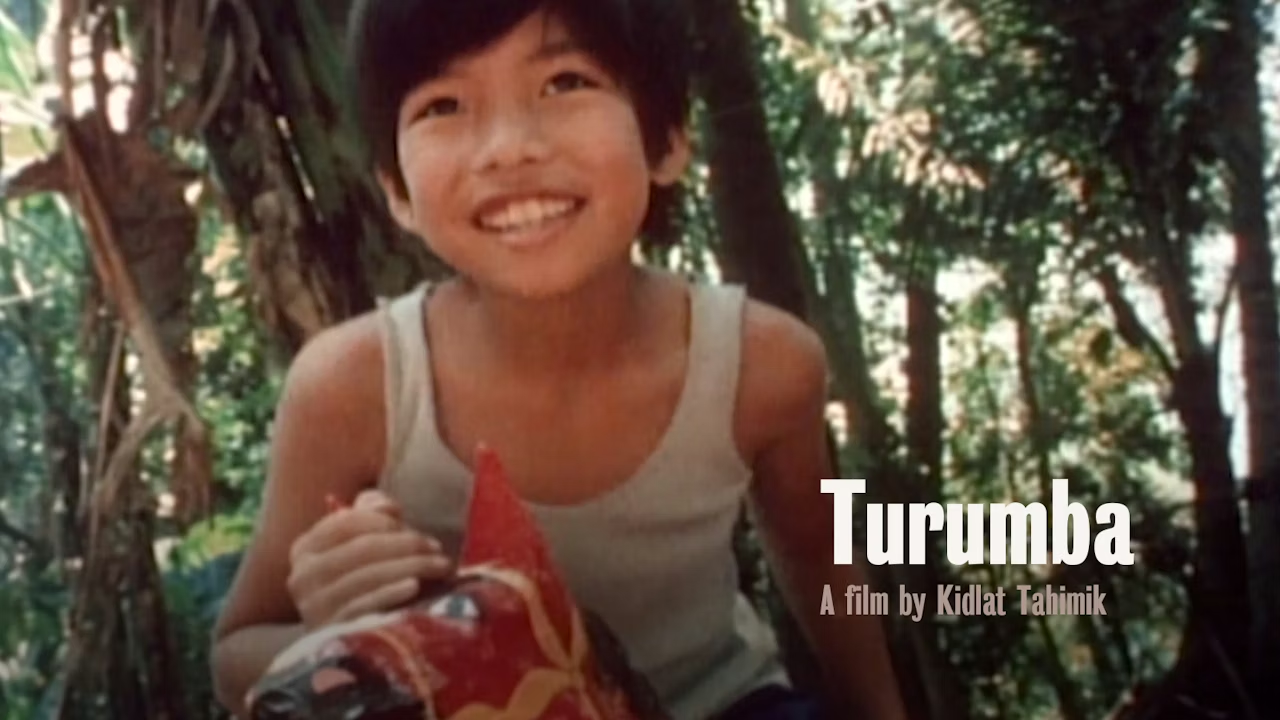
Another film demonstrating how dominant institutions profit from marginalized labor was Kidlat Tahmik’s Turumba using a documentary type focus story about how the creative paper mache artistry of villagers are exploited for Western profit and cataloguing this loss in memory. This prompted thoughts of how to make work where it supports the subject or object of the work?
In my other IMA courses this semester in Mediated Movement with Jada Robertson Charon and Documentary 1 with Edwin Martinez there was resonating of the similar questions arising about making work, how to proceed, and how to make it in a relational and decolonized way which feeds back into my inquiry about Third Cinema and follows these ideas of accreditation and who makes the work..
Mediated Movement is an exploration of dance on film, with practical work making dance documentaries with social justice themes, as well as analysis. It was through this work that the legacy of not crediting black performers for their innovation and creation became evident. Despite a societal and cultural awakening in the USA brought about by the Civil Rights movement and later the Black Lives Matter movement, responsibility, justice and credit is only forthcoming unless pressure is continually exerted, whether by protests or social media shaming and protest again led by the disenfranchised and its allies.
One contemporary example is the non-crediting of dance work – dance steps and dance practices – that go viral on social media but originate with black teenage girl performers like Anaya Price (D1 Nayah) and Jalaiah Harmon, and written extensively about in Trevor Boffone’s Renegades. Is there a way to credit the work through hashtags when the algorithm might obliterate the originator? How to find the originator when social media platforms are often not connected?

Similar questions were being raised too in Edwin Martinez’s Documentary 1 when students asked who gets to film a community. Bringing up the question of when an artist comes up with an idea for a documentary – exposing a gap in social policy, or perceived wrongdoing, how to achieve the work? How should the artist work with the community that is affected by what the filmmaker thinks typifies the injustice, and what is the sensitive way to work with the community if you are an outsider, and whether the community would even find such work useful to its needs? And who benefits in the end – the filmmaker, the community, or the documentary backers?
Similarly, In a course on Eco-acoustics, a possible way to work with community, involved the composition Song of the Cedars, which contains the sounds of Ecuador’s Los Cedros cloud forest. Through this work a petition was submitted by the sound work’s authors and creators – Cosmo Sheldrake and Robert MacFarlane to Ecuador’s copyright office to recognise the forest as co-creator, and where income from streaming platforms could be shared with a fund for protection. Could this example of copyright protection and recognition be a way to share financial success from the work in filmmaking?

Studying Third Cinema shifted my understanding of documentaries away from authorship and representation toward relationship-building, collective memory, and infrastructure support.
In Zhang Mengqi’s Self Portrait: Dancing at 47KM the filmmaker achieves a method of cementing memory in community recognition and memorial, and also how to work with family connections and people in a village to build upon relationships. She documented her personal connection to the village through family by seeking interviews with a grandparent and builds upon those connections through inquiry and requests to include more members of the village. She then documents her interactions asking and seeking financial support for the project, while building consensus and support towards a task of memorializing the four year famine during the Chinese Cultural Revolution. She further shows through a dance performance, collective memory gathering, and erecting a memorial to commemorate those who had died during the famine but also a tribute to those who survived the famine. It is a powerful example of a project built on patience, dedication and vision.

It was the combination of all these Third Cinema works and the questions raised in my other courses that helped me reach the conclusion that the most ethical role I can take is in perhaps not directing at all but in producing, facilitating, teaching, funding, distributing, archiving and helping build media infrastructure for others.
REFERENCES:
The Hour of The Furnaces (Argentina, 1968, by Octavio Getino and Fernando Solanas) Follow links to Pt1-2-3. (Pt1: Neocolonialism and Violence, Pt2: Act for Liberation, Pt3: Violence & Liberation)
Self Portrait: Dancing at 47KM, dir. Zhang Mengqi (2012). 77 min.
The Original Reneged – Dubsmash, Hip Hop Culture, and Sharing Values in a Digital Space, Renegades, Trevor Boffone, Oxford University Press 2021.
Em bé Hà Nội (The Little Girl of Hanoi) (dir. Hai Ninh) (1974)
Turumba (1981, Kidlat Tahimik, The Philippines. 89min.
https://www.theguardian.com/world/2024/oct/25/legal-bid-for-ecuador-forest-to-be-recognised-as-song-co-creator