

by Vi Tuong Bui
Lotus in the Sea of Fire
 Two weeks ago there was a fire at my apartment building. When the FDNY was banging on our door yelling to evacuate, my roommate yelled from across the apartment for me to bring my wallet. I couldn’t find it. I grabbed my first edition (1967) copy of Lotus in the Sea of Fire by Thích Nhất Hạnh instead, running down the stairs of the building. My apartment unit was luckily unaffected by the fire and I was able to return, but I keep thinking about how I chose that one book to bring with me as I evacuated. As a Việt kiều born and raised in the U.S. by former refugees who gazed at their new life with diasporic nostalgia, I have always traced my existence from the American War in Vietnam. It is hard to live here in the heart of the empire and sit on the subway in New York next to men who wear Vietnam War Veteran hats, but, simultaneously, it is also a gift to remember that I come from a lineage of people who overthrew a century of Western imperialism. This all flows into my work as an artist/researcher and has impacted how I have encountered film industries (festivals, galleries, distribution).
In Nothing Ever Dies: Vietnam and the Memory of War, Viet Thanh Nguyen argues that “an industry of memory includes the material and ideological forces that determine how and why memories are produced and circulated, and who has access to, and control of, the memory industries…Struggles for memory are thus inextricable from other struggles for voice, control, power, self-determination, and the meanings of the dead. Countries with massive war machines not only inflict more damage on weaker countries, they also justify that damage to the world. How America remembers this war is to some extent how the world remembers it…By far the most powerful of its kind, the American industry of memory is on par with the American arms industry, just as Hollywood is equal of the American armed forces” (Nguyen, 107-108). These words serve as a starting point for my research.
Research Questions
*This research project is a point of arrival and departure, looking for answers on the following questions:
-
-
- How do films made by Vietnamese people, whether from the National Liberation Front or from Vietnamese diaspora, unsettle and resist the power imbalance within what Viet Thanh Nguyen calls the memory industry around the American War in Vietnam / Vietnam War?
- What distribution models can serve as generative vessels to uplift these films, counter the historically asymmetric power imbalance around “memory industries,” and politicize the Vietnamese arts community?
- How have Vietnamese artists/filmmakers in Vietnam organized in the spirit of Third Cinema in their local contexts?
-
Vietnamese Filmmakers + Unsettling the “Memory Industry”
Em bé Hà Nội (The Little Girl of Hanoi), Hai Ninh, Commissioned by the Communist Party, 1974

Having survived the December 1972 American bombing campaign, the director Hai Ninh considers the film to be a memorial to remember those who have been killed. A little girl walks through Hanoi looking for her father who is a soldier. The bombing campaign, which lasted for 11 days straight (largest saturation of bombing campaign during the war) is known as Operation Linebacker II.
In Qui-Ha Hoang Nguyen’s article Cinema of Care: The Child Figure, the Collective, and War in The Little Girl of Hà Nội, Qui-Ha Hoang Nguyen discusses care networks as wartime ad hoc social structures. As Nguyen argues, the Vietnamese people were not passive receivers to the dominant trope of traumatic memories.
The Sounds of Cannons Familiar Like Sad Refrains / Đại Bác Nghe Quen Như Câu Dạo Buồn, Andrew Tuan Nguyen, 2021
 The two-channel video installation shows archival footage from U.S. Army next to footage of the author’s footage of locals safely deactivating an unexploded ordance (UXO) in the Quảng Trị province, which is a UXO hotspot in the Mekong region. Through animism, the UXO takes on a life and speaks throughout the video. The film is a part of an ongoing project to contribute to healing towards the land.
In Keva Bui’s article Eugenic Ecologies of Herbicidal Warfare in the Vietnam War, they discusse disability justice, the legacy of herbicidal violence that Americans used in the war from chemicals such as napalm and Agent Orange: “Within a biopolitics of debilitation, the objective is not death per se, but the disruption of a population’s capacity for future resistance and noncapitalist trajectories of life, thereby facilitating an acquiescence to colonial and imperial order” (Bui, 317).
These two films are a few examples of Vietnamese works that unsettle the “memory industry” by depicting the impact of war through centering the Vietnamese perspective—they are gestures towards resistance against the continued violence towards a land and people that have been dispossessed.
Vietnamese Led Film/Art Distribution Models
Vietnamese arts/film funding and support is extremely limited and Vietnamese galleries, festivals, and arts gatherings are always subject to approval from the culture police. Organizers must seek permits from the governments to host events and events and organizations are at risk of being shut down and censored. Different iterations of Nhà Sàn Studio and Nhà Sàn Collective have been shut down several times.

Nhà Sàn Studio was founded by artists Nguyễn Mạnh Đức and Trần Lương in 1988. Nhà Sàn Studio is the longest running non-profit experimental art space in Vietnam. The studio nurtured several generations of the most imaginative and contemporary artists in Vietnam. The studio was at Nguyễn Mạnh Đức’s family home and built as a Mường style house on stilts, which was transported from the mountains of Hoa Bin to a neighborhood on the periphery of Hanoi. The studio offered a space for international art exchange and hosted lectures, workshops, sound, video installations, and performance art. Artists experimented with art forms outside of state pedagogy and commercial markets. Nhà Sàn Studio hosted international projects and artists in Vietnam, opening up opportunities for Vietnamese artists to make connections with artists abroad.


In 2008, They applied for funding from The Cultural Development and Exchange Fund (CDEF) to put on a show celebrating the 10th anniversary of the studio for the 20 collective members where they used every part of the house (bedroom, kitchen, guest bedroom, outside, up to the trees in the yard) to put on the show.
The studio helped the late Vietnamese-Cambodian artist Le Huy Hoang realize and organize two exhibitions over two years, Khan (Scarf) and Mua (Rain). Through his art, Le Huy Hoang explored his Cambodian-Vietnamese identity and (familial) memories around war. Le Huy Hoang had a complicated and estranged relationship with his father who was a solider and fought with the Viet Minh and Pol Pot. Le Huy Hoang served as a soldier in battlefield in Cambodia and spent five years in a prison camp in Thailand where he learned how to paint.
Nhà Sàn Studio nurtured the first generation of Vietnamese avant-garde artists in the early 1990s These artists include Trương Tân, Trần Lương, Nguyễn Văn Cường, Nguyễn Minh Thành, Nguyễn Quang Huy, Ea Sola, Nguyễn Mạnh Hùng, Phạm Ngọc Dương, Nguyễn Minh Phước, Nguyễn Xuân Sơn (Sơn X), and Kim Ngọc. In 2011 the studio closed indefinitely due to pressure from authorities. Following the closure of the studio, a younger generation born out of some community members of the studio started Nhà Sàn Collective…

Nhà Sàn Collective is an independent artist collective in Hanoi. In 2013 a group of friends set up a public space in an abandoned medicine factory called Zone 9 to host 11 exhibitions, 13 open studios, and two festivals over a period of six months. After six months the physical space in the factory was shut down by authorities, The collective is made up of Nguyen Quoc Thanh, Tuan Mami, Vu Duc Toan, Truong Que Chi, and Nguyen Quoc Thanh. The group frequently works with collaborators from outside of the organization to organize exhibitions, workshops, film screenings, talks, and other activities to serve as a supportive platform for artists in the community.


Queer Forever December, 2015. The project showcased artworks of Vietnamese and international artists and explored the complexity of queerness within the context of Vietnamese culture, challenging social norms through perspectives on art, culture, and social relations. Guest lecturers spoke on queerness related to literature, films, media, contemporary paintings, and visual arts. The festival aimed to exchange knowledge, experiences, and research between different creative communities (art, film, literature, science, and social development.

“We wanted to analyze queer in the social context of Vietnam, why it is subjected to certain social norms, social disadvantages and advantages.”
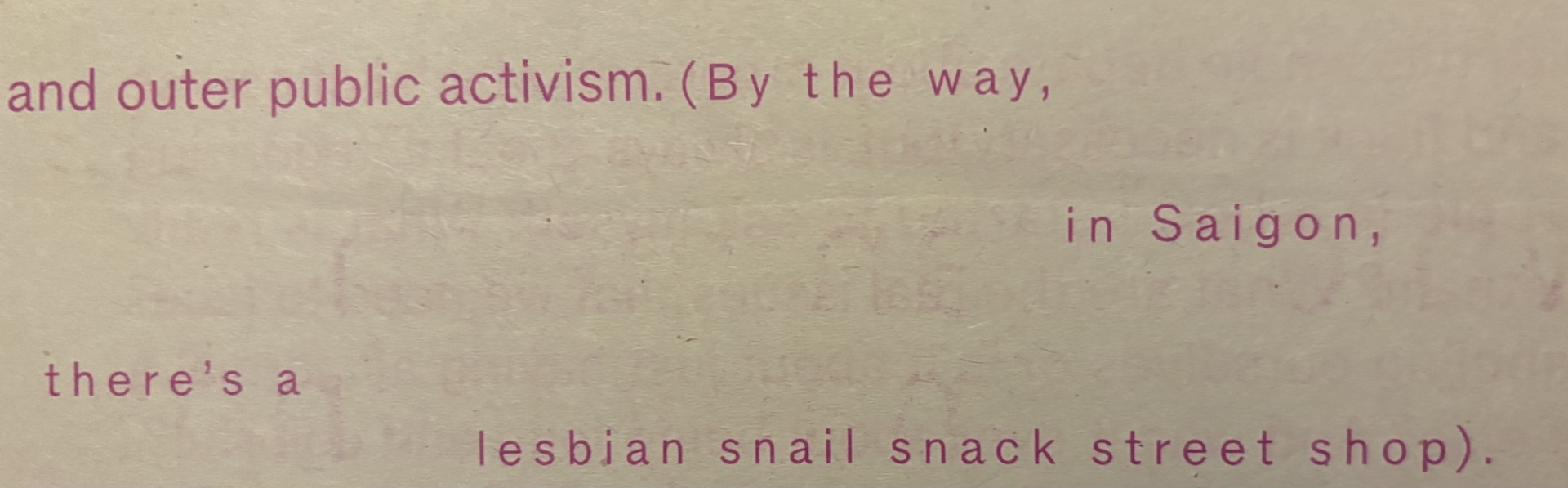
Nhà Sàn Collective was forced to relocate to Ly Quoc Su and Hanoi Creative City and fell into a pattern of being somewhat nomadic and untethered to a physical space. Nhà Sàn Collective is very much inspired by the spirit of the Nhà Sàn Studio with one of the co-founders of the collective having grown up in the house of the studio. Today the collective continues to host a series of mobile and guerilla projects in public spaces and large scale projects with international institutes in Vietnam and abroad. The group relies on volunteers, private donations, and support from cultural institutions both local and abroad. 1A note that the group accepts funding from the Goethe Institute, which in recent years has shown support for Israel. As noted, there is very little local arts/film funding in Vietnam. Funding from international organizations is often the only institutional support available to Vietnamese groups.
“With or without a physical base, we approach artmaking with a just-do-it attitude that doesn’t always yield answers and remains unconcerned with simple outcomes” (Nguyen Phuong Linh, 67, MRPJ).

More Examples of Vietnamese Led Film/Art Distribution
Saigon International Film Festival: A film festival highlighting experimental short films whose mission is to create more opportunities for Vietnamese filmmakers and Vietnamese audiences to experience new cinematic visions.
A Queer Museum: Feminist/Queer archive space hosting community events, film screenings, and discussions in Hanoi.
Nguyễn Art Foundation: Contemporary art space in Saigon facilitating artistic and intellectual exchange through their Collection, Exhibitions, Education, Public Programs, and Development Projects. Prioritizing experimental practice and creating space for artists in Vietnam to express and show their work outside of nationalist perspectives.
Sàn Art: Founded in 2007 by Vietnamese returnee artists2To learn more about returnee artists read Beyond Yet Toward Representation: Diasporic Artists and Craft as Conceptualism in Contemporary Southeast Asia, Pamela N. Corey Dinh Q. Lê, Tuan Andrew Nguyen, Tiffany Chung, and Phunam. Independent arts organisation in Saigon and the region. Maintaining a commitment to grassroots support for local and international artists and cultural work. Currently on hiatus.
Nãi Cinema: Independent film initiative organizing screenings across Saigon.
Te Rẹt Collective: A collective of younger artists, thinkers, curators organizing impromptu events, performances, and screenings.
Super Boat People: Cambodian, Laotian, and Vietnamese organization based in Montreal. Primarily 2nd generation engaging in building community, research, documentary, arts, and media.
Reflections
How can filmmakers/artists of the Vietnamese diaspora learn from Nhà Sàn Studio and Nhà Sàn Collective? The artists remain concerned with their local conditions and organize screenings, events, and discussions to uplift their arts community. While artists in Vietnam self-organize events because of the lack of arts/film funding, their autonomous efforts connect to the spirit of Third Cinema in working outside of formalized institutions. In the future, I hope to contribute to a Third Cinema inspired arts/film ecosystem for Viet artists, organize a political education workshop for Việt kiều artits/filmmakers, and make a project surrounding the ecological impact around the American War in Vietnam.
May 11, 2026
Sources
Nothing Ever Dies: Vietnam and the Memory of War, Viet Thanh Nguyen
Cinema of Care: The Child Figure, the Collective, and War in The Little Girl of Hà Nội, Qui-Ha Hoang Nguyen
Eugenic Ecologies of Herbicidal Warfare in the Vietnam War, Keva X. Bui
We Exist in the Ambivalence of Those Motherfuckers, maura nguyễn-donohue, Lumi Tan, Anh Vo, 2025
https://www.youtube.com/watch?v=HFxVz_dYgXg